At Recent WQCC Meetings, NMED Did Not Disclose Its AI Data Contracts Involving Project Jupiter Consultant and Lobbyists


Via a Series of No-bid Contracts of at Least $1.4 million, Secretary James Kenney Directed State Employees to Turn Over the State Environment Department’s Library of Water, Air, Environmental Data, Permits, Compliance Reports, etc. to Consultant and Lobbyist for Data Centers and Oil and Gas Clients …
(See Editor’s update/note of clarification and additional information at end of this article.)
On April 14, 2026, during a meeting of the New Mexico Water Quality Control Commission, Jonas Armstrong, the Director of the Water Protection Division of the New Mexico Environment Department (NMED), recommended that the Commission members take up a petition to change the “Produced Water” rules it had adopted less than a year earlier, and which environmental advocates fought hard for and felt provided protections of the state’s various sources of water and aquifers.
The Commission heard a presentation for the proposed Produced Water rules changes from representatives of the petitioners Water Access Treatment & Reuse Alliance (WATR), the City of Bloomfield, and Lea County.
Several environmental advocacy groups spoke against the Water Quality Control Commission (WQCC) granting the petition a hearing, arguing that it represented the interests of oil and gas industry insiders who were opposed to the rule-making adopted last year.
The environmental groups noted that the rule approved in May of 2025, provided protections that were needed and that it was adopted after a year and a half of hearings, involving expert testimony, and thoughtful deliberations.
In addition, they pointed to an already discredited attempt in the summer and fall of 2025 by WATR, Governor Michelle Lujan Grisham, and NMED Secretary James Kenney to get new and more permissive produced water rules ‘over the finish line,’ as reporter Nick Gilmore of the Santa Fe New Mexican revealed in a September 2025 article.
It was decided by the Commission that it would wait until its May meeting to decide on whether to grant the petitioners’ request to hold hearings on its Produced Water rule-making proposal.
In addition to his appearance and comments putting NMED on record in support of the WATR proposal at the April WQCC meeting, Armstrong sent a letter to the Commission four days before the May meeting doubling down on NMED’s support for WATR’s proposal, writing, “A formal hearing process allows the Commission, PWRC, the public, and NMED to evaluate each of these components thoroughly and transparently.“
At the May 12th meeting, an NMED attorney joined attorneys and lobbyists Matthias Sayer and Jennifer Bradfute and took questions from the WQCC members relative to, among other things, whether the sponsors of the various new studies and providers of new information about successful treatment of produced water were related to, or sponsored by, industry interests.
Bradfute and Matthias also reported to the WQCC members that they had numerous meetings with NMED officials to develop the proposal.
What wasn’t revealed to the WQCC members, was their association with a fledgling Artificial Intelligence Agent interface development company that had partnered with NMED – something that at least NMED counsel and Armstrong likely should have been transparent about.
Armstrong and the NMED assistant general counsel are likely aware that an agency-wide NMED records digitization plan involved the contracting of the company Apaluma, Inc., to develop the artificial intelligence (AI) agent interface and,
“…ingest approximately 20+ million pages of Procuring Entity documents, develop a Retrieval-Augmented Generation (RAG)-based Artificial Intelligence (AI) Agent system and associated User Interface (UI) for browsing ingested documents and interacting with the AI Agent, and provide public and Procuring Entity staff user access via RESTful APIs through both web and mobile applications.” (From the stated Purpose in the contract.)
The project involves the use of millions of pages of agency controlled records – a virtual library of publicly owned data that should be protected against any misuse, inadvertent or intentional – and protection against any perceived misuse.
Armstrong oversees the Drinking Water Bureau, the Ground Water Quality Bureau, the Surface Water Quality Bureau, and the Construction Programs Bureau, reporting directly to Environment Department James Kenney.
Those bureaus, along with the Air Quality Bureau and other divisions of the NMED, beginning in April of 2025, were designated to participate in and be impacted by the artificial intelligence (AI) agent interface platform being developed by Apaluma.
Bureaus under Armstrong’s control have already had records exposed to the project being run by Apaluma – as have the Air Quality Bureau.
NMED named the plan “Project Velocity.”
Project Velocity’s AI Agent interface is financially supported through a serious of NMED contracts and amendments with a company named Speridian Technologies LLC (Speridian).
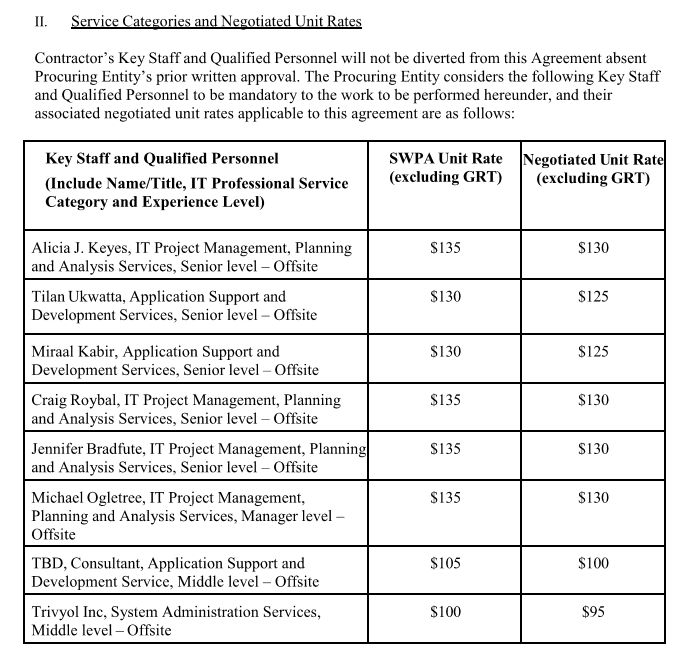
As The Candle reported in March, without developing a request for proposals for the introduction of the AI component to the digitization project, Secretary Kenney directed NMED employees to amend one contract with Speridian to incorporate language to include Apaluma’s role, and in another subsequent contract required inclusion of Apaluma and Apaluma’s CEO, Alicia Keyes, and other Apaluma employees and associates, as products and “Key Staff and Qualified Personnel to be mandatory to the work to be performed” in the contract.
NMED added at least $1.4 million during 2025, to the Speridian contracts to compensate Apaluma and its associates named in one of the contracts (see below chart from contract):
More Background
Earlier contracts between Speridian and NMED that predated the inclusion of Apaluma were apparently reviewed by personnel at New Mexico Department of Information Technology and signed by Manny Barreras, Cabinet Secretary and State Chief Information Officer New Mexico Department of Information Technology (DoIT).
However, from the records The Candle received from an Inspection of Public Records Act request, through at least one amended contract, and one subsequent related contract, the scope of the project evolved into one that introduced the development of an Artificial Intelligence (AI) Agent system, and for which it is not clear if DoIT personnel were asked to review and approve the expansion (via the new contract), or if the DoIT Cabinet Secretary signed approval for the expansion contract.
The inclusion of an AI Agent System developed by Apaluma, Inc., Alicia Keyes and their associates is a concern, as at least some of those individuals are also consultants or lobbyists for entities that have or will have matters before the NMED Secretary and the air and water bureaus.
In January and February of 2025, Bradfute and Sayer were listed as lobbyists for Apaluma, BorderPlex Digital Assets, LLC (the originator of what has become known as Project Jupiter) and various oil and gas and produced water related companies.
Apaluma’s CEO, Alicia Keyes, has also been identified as a consultant or advisor to BorderPlex Digital Assets, LLC.
A permit application related to Project Jupiter through an associated company, is currently before the NMED Air Quality Bureau, and will likely require action of Secretary Kenney in the process that involves permitting.
It is a legitimate public concern that a developer of an AI Agents system for NMED not be even remotely connected with entities that are, or may eventually, be subject to the regulation of NMED’s bureaus … or its Secretary … using the AI Agent system.
Conflicts of interests, whether real or perceived, have no place in governance.
The Candle will be filing at least two additional articles regarding the timeline and involvement of NMED personnel in the produced water proposed changes and the connections of the Apaluma and associates development of Project Velocity to Project Jupiter …
Editor’s Note/Update.
The editor received a letter from attorney Jennifer Bradfute demanding a correction of some of the information reported above regarding her and her firm’s relationship to the matters The Candle reported.
We provide in the following, clarifications sent to us by Ms. Bradfute.
Ms. Bradfute wrote that neither her firm nor she have any legal conflict of interest in connection with these matters, neither the firm nor she have any legal obligation to disclose anything to the WQCC, and that neither the firm nor she had any ongoing Apaluma engagement at the time of the spring 2026 WQCC meetings.
We provide the above clarification from Ms. Bradfute, while emphasizing that none of the reporting in the story stated that she or her firm had a legal conflict of interest, nor did the story state that she or her firm had any legal obligation to disclose anything to the WQCC.
As to her and her firm’s engagement with Apaluma, we reported that “In January and February of 2025, Bradfute and Sayer were listed as lobbyists for Apaluma, BorderPlex Digital Assets, LLC (the originator of what has become known as Project Jupiter) and various oil and gas and produced water related companies.”
Ms. Bradfute provided a further clarification that, “I completed my last work for Apaluma as a lobbyist/outside counsel in September 2025.”
She also clarified that her “principal engagement for Apaluma during the 2025 legislative session was advocacy in support of House Bill 427, legislation to help New Mexico communities deploy real-time water-quality monitoring.”
That legislation failed during the 2025 legislative session, which ended in March of 2025.
Bradfute wrote, “This legislative advocacy was a distinct matter from NMED’s “Project Velocity” records- digitization procurement, which is a project that involves digitizing agency pdf records and making them searchable using web and AI tools. I have never been an employee of Apaluma. Nor did I have control over the document cited in your article.”
To be clear, The Candle never wrote that Ms. Bradfute was an employee of Apaluma. The document cited in the article is contained in a Speridian/NMED contract directly related to Project Velocity, covering the period of time from July 1, 2025, through June 30, 2026. [See pdf of contract below.]
Ms. Bradfute also wrote, “The produced water rulemaking now before the WQCC is a completely separate/unrelated matter.”
Noting her statement that her last work for Apaluma as a lobbyist/outside counsel was completed in September of 2025, it is also noteworthy that in June of 2025, the WQCC had before it a predecessor produced water rulemaking petitioned by the Water Access Treatment and Reuse Alliance, which was represented by Ms. Bradfute.
Ms. Bradfute also wrote that The Candle should have disclosed that the author of the article, editor Bruce Wetherbee, had filed an entry of appearance to both June 2025 and March 2026 WQCC petitions filed by Ms. Bradfute’s clients.
Despite there being no legal requirement to disclose, and further, that it is a matter of public record that Wetherbee has filed the entrance of appearances, The Candle has no problem in so acknowledging Wetherbee’s participation in the rulemaking – such participation being afforded to any person so interested – and will disclose the same in subsequent reporting on these matters.
Speridian/NMED Contract: