Abuse of New Mexico State Procurement Process is Historically Disturbing
For Years Governors and Lawmakers Ignored the Warnings of Legislative Staff that New Mexico’s Procurement Code Is Broken.
It’s been almost a decade since New Mexico’s Legislative Finance Committee (LFC) staff first warned legislators of the need to reform the purchasing code, and require more accountability and oversight.
In 2016, 2019, and again in 2021, the LFC staff noted examples of improper use of sole source contracting and emergency contracting – two provisions of the state’s procurement code that are supposed to be used sparingly.
Sole Source purchasing (a no bid process), is responsible for hundreds of millions of dollars in spending – much of it in purchases from out of state companies.
And Emergency purchases (amassing to more than a half billion dollars), even understanding that emergencies require swift action, have also been questioned by legislative staff, regarding the potential misuse in the categorizing of some that spending.
In October 2021, the LFC Program Evaluation Unit warned legislators of purchasing problems in a report entitled, “Obtaining and Maximizing Value in State Procurement,” writing,
“… as highlighted by LFC over two evaluations in the past five years, state law, management decisions at the State Purchasing Division of the General Services Department, and noncompliance by state agencies have often led to the state overspending for purchases ranging from everyday acquisitions of laptops and cars to noncompetitively sourced contracts worth hundreds of millions of dollars.”
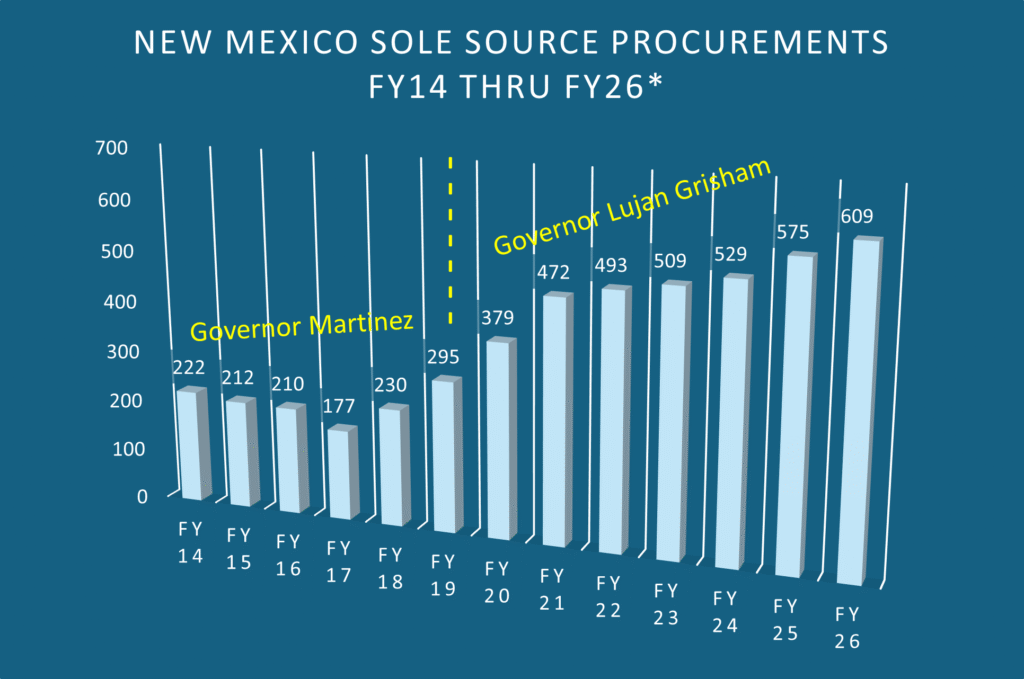
In November (2025), The Candle reported on Sole Source purchasing records of state and local government agencies during former Governor Susana Martinez’s administration and finding a dramatic doubling of that type of purchase for goods and services during Governor Michelle Lujan Grisham’s administration.
Agencies like the Department of Workforce Solutions, the Environment Department, and the Public Education Department, to name a few, continue to engage in sole source purchasing in the tens of millions of dollars with very little explanation as to why they had not planned better or developed requests for proposals.
Typically the agencies use excuses that the companies they chose for the procurements were unique, and that no other entity in all of the country could provide the service the agency needed.
Many times, they just renew a contract year after year, claiming it’s the only choice the agency can make.
And many of the purchases are from out of state companies – as the state agencies ignore any serious effort to engage potential New Mexico businesses or organizations with an opportunity to weigh in with a proposal.
(Note: Legislation passed in 2019, required all state agencies to report annually to the General Services Department (GSD) on the contracts they issued to out-of-state companies and in-state companies. The Candle requested records from GSD regarding that reporting and received a very large excel spreadsheet allegedly containing the information agencies report to GSD on out-of-state and in-state spending. After reviewing it over several weeks, it became evident that the information did not contain many transactions listed on the state’s so-called sunshine portal.)
Next week, The Candle will be reporting on individual contracts the state has entered into with no bidding process engaged in by agencies.
Major Overhaul of Procurement Code Endorsed By Legislative Finance Committee in 2023, Thwarted Without Explanation.
In 2023, Senator Bill Tallman, of Albuquerque, filed Senate Bill 76, a bill endorsed by the Legislative Finance Committee, and drafted by the Senator and LFC staff to address problems cited in the LFC reports from 2016 through 2021.
The fiscal impact report (FIR) for the LFC bill filed by Tallman stated:
“Since 2016, LFC staff has completed two evaluations and one progress report on the state’s procurement systems, highlighting deficiencies in the state’s purchasing practices. Some important recommendations of those evaluations remain unaddressed, including repealing some widely used purchasing exemptions that circumvent competition and adding guardrails to the use of statewide price agreements. This bill addresses many of the evaluation’s statutory recommendations and should result in state savings through increased competitive sourcing.“
The FIR also noted, that “Starting in 2016, the Human Services Department (HSD) determined that most of their contracts for healthcare services were exempt from the Procurement Code under the hospital and healthcare exemption, including all Medicaid managed care contracts and contracts for non-Medicaid behavioral health providers and the statewide behavioral health entity. For Medicaid managed care alone, HSD spent $3.9 billion in FY21 and is projected to spend $4.6 billion in FY23.”
The report also revealed that HSD had begun a “competitive request for proposal process” (which started in September of 2022) for an upcoming contract with managed care organizations for the newly developed Medicaid Turquoise Care program.
The LFC analysts noted that, despite the competitive process engaged by HSD at that time, passage of “Senate Bill 76 would ensure that these billion-dollar contracts would be negotiated using a competitive process outlined in the Procurement Code.”
Much to the frustration of Tallman, and despite the bill being an endorsed measure of the LFC, the bill died in the Senate without receiving a single hearing.
Senate Bill 76, was scheduled to have its first hearing on Thursday, February 16, 2023, before the Senate Tax, Business & Transportation Committee, and Tallman, as well as the director of the LFC, and the lead analyst and support staff of the LFC procurement studies, were all in the hearing room that day to explain the importance of bill.
Tallman, who has since retired, told The Candle that as he was preparing to present his arguments before the Senate Tax, Business & Transportation Committee, the Chairman of the committee, Senator Benny Shendo, Jr., informed him the bill would not be addressed.
According to Tallman, Shendo told him Governor Michelle Lujan Grisham did not want the bill to be heard.
The Candle emailed Senator Shendo on November 13, 2025, and again on January 2, 2026, asking to speak with him about the bill, and to confirm that he was asked by the Governor or her staff to make sure the bill did not get a hearing.
Shendo has been silent, never responding to the emails seeking a statement.
Not getting a hearing for a Legislative Finance Committee endorsed bill is highly unusual.
With no hearing, the bill was postponed indefinitely (API) – in other words the reform bill was dead.
Tomorrow, The Candle will report new information regarding the timing of the alleged Governor’s request to kill the bill and the possible connection with what was eventually revealed regarding Governor’s involvement in blocking a bid process for Turquoise Care Medicaid Managed Care Request for Proposals at the end of January 2023.