How Trump’s Expansion of Federal Power Threatens States’ Authority

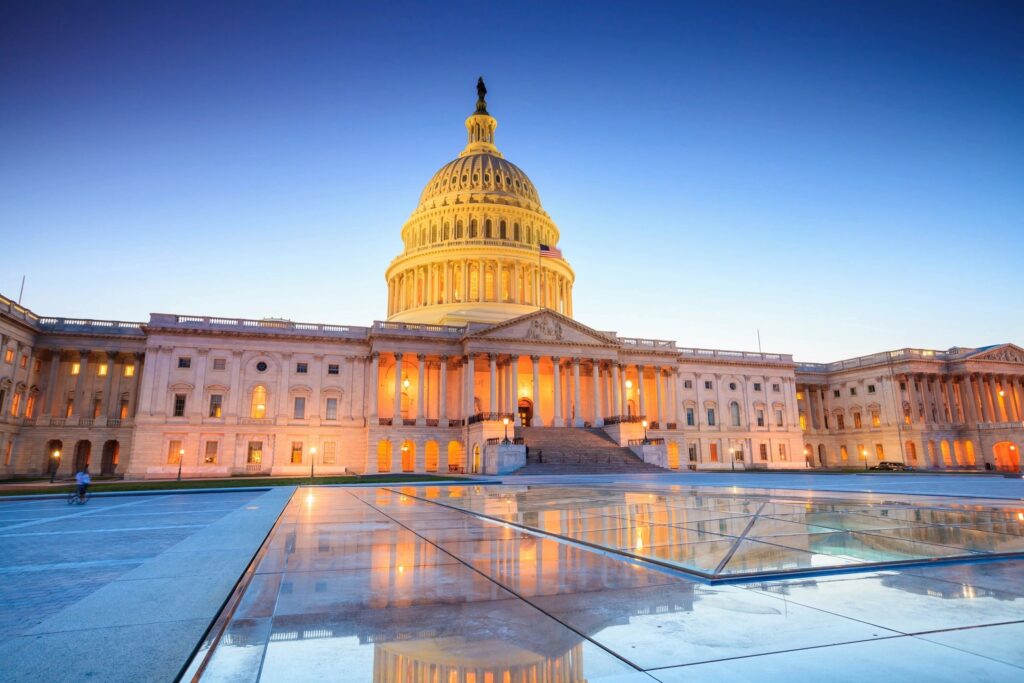

Originally Published in Stateline – March 30, 2026
by Jonathan Shorman and Kevin Hardy, Stateline
As the United States of America marks its 250th anniversary this year, the relationship between the states and the federal government is approaching a breaking point.
Led by a bellicose president, the executive branch has moved to dominate states, resulting in more than a year of escalating confrontations between the two levels of government.
President Donald Trump has worked quickly: In the first year of his second term, he surged thousands of immigration enforcement agents into a resistant Minneapolis and other cities, with fatal results. He seized control of the National Guard in some states against the will of governors.
His administration is trying to force states to turn over sensitive data on millions of voters ahead of the midterms. And it is blocking states from receiving, and distributing to their residents, billions of federal dollars for child care, public health, housing and a host of other congressionally approved programs.
Political parties have swung in and out of power in Washington for centuries, and recent administrations have increasingly clashed with states run by the other party. This time is different, dozens of sources in and around government told Stateline.
Trump and a coterie of loyal aides have set out to remake the nation in the president’s image. Along the way, retribution and raw power have become the administration’s primary tools to bend recalcitrant states to its will. Grants are pulled, armed force deployed, disaster aid withheld.
The states have repeatedly gone to court, asking the federal judiciary to rein in the executive branch. They have also started testing the bounds of their own authority, such as moving to restrict the actions of federal immigration enforcement agents.
The past year has led to a period of sustained state and federal conflict without parallel in modern U.S. history. The consequences for Americans over time will prove enormous, shaping the very nature of our government.
“This kind of battle between the federal government and the states, we’ve just never seen that before and it makes no sense,” said former New Jersey Gov. Christine Todd Whitman, who was elected as a Republican but later helped co-found the centrist Forward Party.
Tensions between the states and the central government are as old as the nation itself. Alexander Hamilton famously favored a strong central government, while James Madison offered the Bill of Rights — including what became the 10th Amendment, which reserves for the states and the people those powers not delegated to the federal government.
But current strains are testing the bedrock principles of federalism, the uniquely American system created by the framers of the Constitution of power sharing between Washington, D.C., and the states.
Ahead of the 250th anniversary of the country’s founding on July 4, Stateline is exploring how the Trump era is transforming the relationship between the states and the federal government. This article is the first in an occasional series, The 50 vs. The One, that will examine the current fraught moment and what evolving — and often deteriorating — state-federal ties mean for the country, now and in the future.
In interviews and public remarks, current and former elected officials at all levels of government, as well as experts on American government, have described the country as approaching a pivot point. Trump’s second term could mark a defining moment for American federalism, one that will be studied in history books alongside Reconstruction, the New Deal and the Civil Rights Movement.
The United States will either continue to adhere to the principles of federalism, they say, or it will take a significant step toward a more powerful central government that sidelines the states.
“We are in a period of challenged federalism,” said Lisa Parshall, a federalism researcher and political science professor at Daemen University near Buffalo, New York. “The fact that we’re here talking about federalism tells you something about the current state of American politics.”
Dramatic Changes
Fears of diminishing state authority have animated state officials over the past year. Republican lawmakers in Utah have invested in federalism education and expanded a group to assess state-federal boundaries, for instance.
In July, Minnesota Gov. Tim Walz and Kansas Gov. Laura Kelly, both Democrats, publicly abandoned the nonpartisan National Governors Association, in part because they said the organization was not doing enough to protect states’ rights. Kansas Democratic Gov. Laura Kelly answers questions about federalism during an interview with Stateline in February. Kelly called states the “laboratories of democracy.” (Photo by Sherman Smith/Kansas Reflector)
States are “laboratories of democracy,” Kelly said during an interview in February, using a classic civics textbook description. States have traditionally operated with relative freedom to pursue their own agendas and solutions to the challenges they face. In turn, states learn from one another.
“That’s been the beauty of it,” Kelly said. “If that’s to go away, if the federal government were — and they are, at this point — undermining states’ authority and responsibility, I think you end up slowing down the entire country.”
In the same way the three branches of government — the legislative, the executive and the judicial — provide checks and balances on one another, federalism imposes a state check on federal power. The U.S. Constitution, which went into effect in 1789, ensured states would command broad power over local commerce, policing, elections and other matters within their borders.
But Trump has at times raised doubt about whether he will always follow the Constitution and has claimed that he can ignore some of its requirements.
Last spring, Trump replied “I don’t know” when asked whether he needed to uphold the U.S. Constitution in the context of due process for immigrants. In 2022, he said massive election fraud allows parts of the Constitution to be terminated. And after his 2020 election defeat, he urged then-Vice President Mike Pence not to certify the results, even though the vice president has no constitutional authority to do so.
In February, Trump asserted that “states are just an agent of the federal government” as he called to “nationalize” elections. Under the Constitution, the responsibility of running elections belongs to the states.
Trump’s critics fault the Republican-controlled Congress for failing to challenge his sweeping assertions of executive power. His administration’s efforts to withhold from states billions in dollars appropriated by Congress, for instance, have spurred relatively little outrage among GOP lawmakers.
“What I think we’re seeing now is a whole different system of crushing state and local government,” said U.S. Rep. Emanuel Cleaver, a Missouri Democrat who has been in Congress since 2005. “And bowing down to a new system where we are almost living in a one-person government.”
In response to questions from Stateline, White House spokesperson Davis Ingle said in a statement: “The Trump Administration faithfully upholds our Constitution and the immortalized American principles of federalism, the rule of law, and the separation of powers.”
Trump and his allies have cast the president as a heroic figure capable of smashing through the machinery of government to achieve results on behalf of his voters and at the expense of his enemies. “For those who have been wronged and betrayed … I am your retribution,” he said in 2023.
He has at times taken steps that his supporters argue empower states, including effectively gutting the U.S. Department of Education, which Republicans have long accused of federal overreach. His appointments to the U.S. Supreme Court during his first term helped cement a conservative majority that in 2022 returned the issue of abortion access to the states.
In a statement, the Republican Governors Association told Stateline the current administration trusts governors to run their own states.
“By cutting government bureaucracy and unnecessary red-tape, President Trump is empowering governors to make decisions that best serve their individual states,” wrote Kollin Crompton, an RGA spokesperson.
Scrambled identities
The U.S. Constitution has been gradually amended in ways that have limited state power, most importantly through amendments that abolished slavery, required states to treat their citizens equally under the law, and prohibited states from denying suffrage on the basis of race and sex.
The federal government has also expanded its reach through legislation. President Franklin Roosevelt’s New Deal in the 1930s and President Lyndon Johnson’s Great Society in the 1960s imposed new economic regulations and created a federal social welfare apparatus that touches nearly every American.
In bid for voter data, Trump’s DOJ lays groundwork to undermine confidence in midterms
Over time, Democrats broadly came to be seen as the party more comfortable with an active federal government and Republicans as the party seeking a more restrained Washington.
But the Trump era has scrambled those identities.
Trump has shown less respect for traditional conservative ideology, such as limited government and a general deference to the authority of states. Instead, he has taken a maximalist approach to executive power.
His actions have placed Democratic state officials in a position of advancing limits on the federal government, whether through lawsuits or legislation. And they have put Republican supporters of the president at odds with decades of conservative rhetoric.
“I do think that progressives are seeing that federalism — there’s a reason it’s in our constitutional order and it isn’t just something that’s left for conservatives,” said Sean Beienburg, an associate professor at Arizona State University who researches federalism and constitutional law.
In Los Angeles, Chicago and Portland, Oregon, Trump deployed federalized National Guard troops onto city streets before courts held him back and he withdrew. For a time, active-duty Marines also patrolled Los Angeles, an extraordinary use of the military for domestic purposes.
Oregon Democratic Attorney General Dan Rayfield, who challenged the deployment of the National Guard in his state, said the fight underscores why lawsuits matter in checking Trump’s power.
“People should be shocked that Oregon has filed 55 lawsuits,” Rayfield said in an interview earlier this year. “Their mind should be blown. But their mind should be equally blown at how often we’re winning these cases.”
The Trump administration has won seven court decisions — and lost 58 — so far, according to a New York Times litigation tracker.
“I do think that progressives are seeing that federalism, there’s a reason it’s in our constitutional order and it isn’t just something that’s left for conservatives.”
– Sean Beienburg, an Arizona State University associate professor
Democratic state lawmakers have also searched for ways to restrict federal immigration agents. In California, Democratic Assembly member Alex Lee has proposed prohibiting state tax breaks for Immigration and Customs Enforcement contractors — a move that could carry national implications because of the size of the state’s economy.
“We also, now, are reasserting what the role of the states and the federal government are,” Lee said.
But among Republicans, Trump has successfully maintained his grip. Many conservative state leaders have supported the president’s most controversial moves, even those criticized as federal overreach.
During President Joe Biden’s term, Texas Republican Gov. Greg Abbott was a staunch proponent of state autonomy and repeatedly challenged the federal government on regulatory issues and its deployment of a state’s National Guard.
But Abbott has supported Trump’s expansion of federal powers, going so far as to authorize the deployment of the Texas National Guard to aid immigration enforcement in Illinois and Oregon.
Republican U.S. Sen. Jim Justice, the previous governor of West Virginia, said federalism remains “alive and well” under Trump. He said he was worried about the nation’s trajectory before coming to Washington in 2025.
“We’ve had to change things,” he said. “There’s new things that are going on that no question they’re disrupting folks on the other side of the aisle.”
Still, other Republicans have pushed back on the administration’s escalating hostility toward liberal states.
Oklahoma Gov. Kevin Stitt sharply criticized the deployment of the National Guard, saying “Oklahomans would lose their mind” if a Democratic-controlled state sent troops to his state during Biden’s presidency.
He has warned that the expanding power and spending of the federal government is dangerous no matter which party controls Washington.
“When we have this powerful of a federal government, it should be frightening for everyone,” Stitt said during a February event at The Pew Charitable Trusts in Washington, D.C.
States Created the Constitution
As the reach of the federal government ballooned over generations, Democratic and Republican presidents have used federal funding to wield more influence over state and local governments.
Federal dollars account for an increasingly large percentage of state revenues, rising from 22% in 1989 to 36% in 2023, according to Pew, which analyzed census and federal economic data. States received more than $1 trillion in federal grants that year.
Over the years, that largesse has encouraged states to pursue policy agendas favored by the current party in power at the federal level.
But Trump has weaponized federal funds in unprecedented ways, experts say. Bypassing Congress and despite numerous court losses, the White House has held up funding for higher education, transit, housing and infrastructure — particularly for states that displease him.
The administration’s attempts to terminate funding for the $16 billion Gateway rail tunnel connecting New York and New Jersey remain entangled in a lawsuit.
New Jersey Democratic Gov. Mikie Sherrill said the White House has caused millions in cost overruns and delays, in what she characterized as the most urgent and consequential infrastructure project in the country.
In February, Politico reported Trump told congressional leaders he would release funding for the project in exchange for renaming Washington Dulles International Airport in Virginia and Penn Station in New York City in his honor.
Parshall, of Daemen University, noted that more state leaders of both parties are pushing to reassert state-federal boundaries — whether in the areas of agriculture or the future of artificial intelligence.
“Federalism scholars are seeing this as a potentially pivotal moment in federal-state relationships,” she said.
Last August, elected leaders gathered at the National Conference of State Legislatures in Boston, where in 1773 colonists hurled chests of tea into the Boston Harbor in protest of Great Britain’s King George III.
At the conference, lawmakers grumbled about a federal government increasingly sidelining states. That organization, representing more than 7,000 state and territory legislators, has consistently urged the Trump administration to respect states’ inherent authority.
Respect states’ rights, new bipartisan group of legislative leaders tells feds
In December, a bipartisan group of more than 40 lawmakers from 30 states gathered to discuss federalism issues, unanimously approving a declaration on the importance of states’ ability to legislate independently.
That document noted that the Constitution did not create the states, “but rather the states created the Constitution, ratifying a framework in which we would both govern collectively and independently.”
New Hampshire state House Speaker Sherman Packard, a Republican, said state-federal tensions have been mounting for decades.
He noted that the major tax and spending law the president signed last summer — often called the One Big Beautiful Bill Act — both cut federal funding to states and saddled them with new costs and administrative work. But it’s just the latest example of what he views as a federal government overstepping its bounds.
“And it’s getting more and more prolific that they’re taking on and doing things that most of us feel is inappropriate,” Packard said. “If we don’t fix this, we’re going to lose state sovereignty altogether. And that’s just not the way it was set up.”
Reporter David Lightman contributed to this story. Stateline reporters Jonathan Shorman and Kevin Hardy can be reached at jshorman@stateline.org and khardy@stateline.org.
Stateline is part of States Newsroom, a nonprofit news network supported by grants and a coalition of donors as a 501c(3) public charity. Stateline maintains editorial independence. Contact Editor Scott S. Greenberger for questions: info@stateline.org.