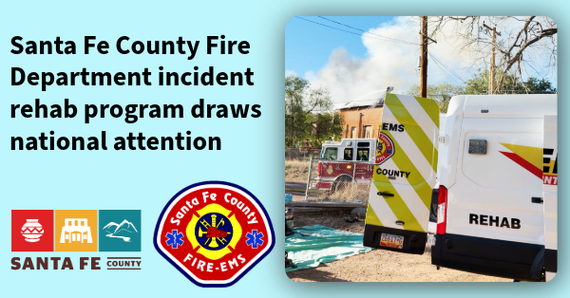
Santa Fe County Fire Department Program Draws National Attention
Press Release – From The Santa Fe County Fire Department
SANTA FE, N.M., July 6, 2026—Through teamwork and dedication to its field personnel, the Santa Fe County Fire Department built a special program to care for first responders at the scene of an incident. That program gained national attention at this year’s National Fire Protection Association conference, one of the top firefighter gatherings in the nation.
Fire Chief Jacob Black, Battalion Chief Ramon Vilorio, and Administrative Services Manager Ignacio Dominguez presented to nearly 9,000 attendees of fellow safety professionals at the conference.
The reality for firefighters is that work conditions are extremely dangerous, with exposure to fire and smoke in all kinds of weather at any time of day or night. They face real hazards to protect lives and property, and they are at high risk of experiencing a cardiac event due to the heavy exertion it takes to answer emergency calls.
In 2024, the U.S. Fire Administration reported that, nationally, 72 firefighters died on duty, and 42 of those were from cardiovascular events.
To help manage the extreme physical demands of the job, occupational standards of care were established in the early 2000s, called incident rehabilitation, or incident rehab. How a department meets those standards can vary greatly.
“It usually consists of a case of lukewarm water, and if you’re lucky, some animal crackers at the scene,” said Santa Fe County Fire Department Battalion Chief Ramon Vilorio.
But Santa Fe County Fire Department wanted to do better than that, and leadership set a goal to improve its incident rehab program to provide more meaningful support for first responders.

Chimayó Assistant District Chief Kelly Torres takes a break with other field personnel in the incident rehab area during the Valentine’s Day Post Office fire of 2023 in Chimayó. Regional and district firefighters, administrators, wildland crew members, and emergency management staff fought the fire all day.
A good incident rehab program should protect firefighters from the immediate impacts of extreme heat, intense exertion, and toxic exposure by providing a space for rest, cooling or warming, medical monitoring, and hydration. On average, firefighters and field personnel are at the scene of a fire for six hours, but double that is not unheard of.
The County program uses pop-up shelters with heaters during the winter or a shaded enclosure to protect responders from wind or extreme heat. In the past, before these shelters were available, firefighters were forced to stand in front of the exhaust coming out of the firetrucks to thaw out their respirators, which had frozen from the spray of the fire hoses during freezing winter nights. They don’t have to do that anymore, because the shelter has a heater for cold weather. It’s also equipped with a portable air conditioner to prevent heat exhaustion and help with recovery.

Firefighters go over the after-action review at a wildland incident a few years ago, while using the incident rehab truck to shade their rest area. This repurposed International ambulance was one of the first renditions of the County’s rehab truck, used to transport rehab supplies to the scene for several years.
Firefighters follow a protocol to use the shelter where they can quickly re-energize with water, electrolytes, a high protein snack, or a meal replacement option, including vegetarian options. It’s stocked with decontamination wipes, so firefighters can wipe toxins, smoke, and grit off their face, and other little items like lip balm.
Providing a brief reset from high-intensity environments helps reduce cognitive overload, emotional strain, and decision-making errors and helps keep firefighters focused and safe.
To make the program a part of Santa Fe County firefighting culture, all department personnel complete a half-day training on how to deploy the incident rehab. The training emphasizes the critical role incident rehab plays in operational effectiveness, responder safety, and overall incident performance. Personnel learn the expectations for operating in and around the rehab area, as well as the strict hygiene protocols involved. All personnel must wash their hands upon entering the rehab area without exception. Learning to operate safely in and around the rehab area keeps the environment clean and teaches field personnel to keep themselves and others safe.

Three agencies responded to this structure fire on a rainy night. The incident rehab deployed a tent to shelter resting personnel from the rain. After using up one or two bottles of oxygen while actively fighting a fire, the firefighter will come out of the immediate danger zone and enter the incident rehab area to prepare to go back in and continue fighting the fire.
For Santa Fe County, incident rehab is not just an afterthought. Rather, it is a fundamental part of the mission to protect lives and property while ensuring the safety of personnel.
The program shows that providing good incident rehab can be done and improves operational response and firefighter recovery, and the County is sharing what it has learned with other first responders. The same kind of program can support HAZMAT incidents, search and rescue operations, law enforcement operations, and disaster responses, and several agencies have asked for guidance to create or expand their own programs.
To learn more about Santa Fe County Fire Department Incident Rehab, contact Administrative Services Manager Ignacio Dominguez at IDominguez@SantaFeCountyNM.gov.